Homecoming
A joyous reunion in northern Minnesota, a family homecoming, and a quiet pilgrimage to to the Minneapolis places that changed me—and so many of us.

I spent last weekend at my 50th high school reunion in Crookston, Minn., population 8,000, a picturesque farming town a hundred miles south of the Canadian border. There were 169 in our 1976 graduating class. About a quarter of my classmates are now gone. Of those who survive, about 70 (and several of their brave spouses) attended, a fine turnout
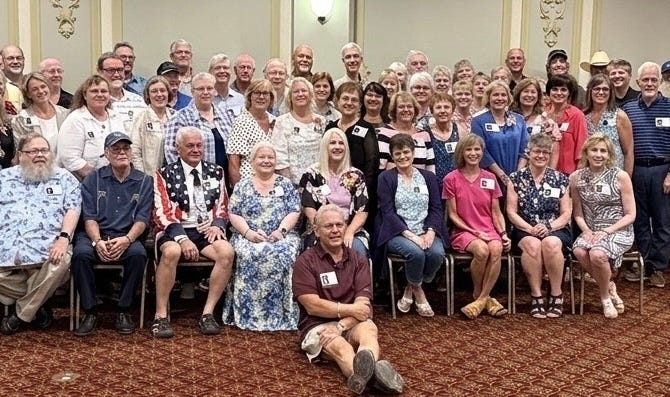
I was admittedly nervous beforehand. It’s hard to know what to expect after all those years. As it turns out, a half-century isn’t all that long. Any awkwardness lasted a few seconds, then it was hugs and laughter; old memories thought to be lost forever, spilling back out, one after another. We caught up as best we could (50 years is a lot of ground to cover) and compared photographs of grandchildren. My new granddaughter was the cutest, but I concede some bias in that regard. We looked at each other, and through the wrinkles, gray hair, and added pounds, found physical vestiges of the young people we used to be. On the inside, however, not much had changed.
Both sides of the political divide were well represented in our gathering, but that rarely came up. Those things were subsumed by different realities—how fragile and fleeting life can be, how fast the years go by; and how the bonds of youth so naturally become the bonds of old age.
On Sunday I made the long drive south to the Twin Cities, where my siblings live. I was the oldest of seven kids that grew up in Crookston. There are five of us left now. We gathered at my sister’s home in St. Paul, and the memories came pouring out again, and we ate brats from the grill and chocolate birthday cake. It was a perfect trip home. Life is good.
--
On a sweltering Monday afternoon, before heading to the airport for my return flight to Texas, I drove to a neighborhood in South Minneapolis, parking in the shade on Portland Avenue South. I walked past a stunning flower garden in front of one home, then came up on the makeshift memorial. It was the place where the vehicle of Renee Good had come to a stop. She was the young mother fatally shot in the head by an ICE agent last January 7.
At the memorial, a few others parked, walked over, and quietly came and went. There were flowers, handmade signs, candles, flags, ribbons, balloons and a massive Teddy bear, each a profoundly personal memento. Good’s death changed me in ways I probably will never fully understand—an atrocity carried out by masked federal agents—one that, to this day, appears to have brought neither accountability nor remorse. It changed so many of us. It was a privilege to stand at that sacred place, to weep and pray.
After 15 minutes, I drove to the spot just a few miles away, where Alex Pretti, a 37-year-old nurse, was shot down by Border Patrol agents. Two young men stood at the memorial that day, speaking in quiet voices, looking down at the familiar tableau, the flowers and signs and portraits of Pretti. A young woman with a black Sharpie looked for an empty space on a crowded wooden panel to add her message.
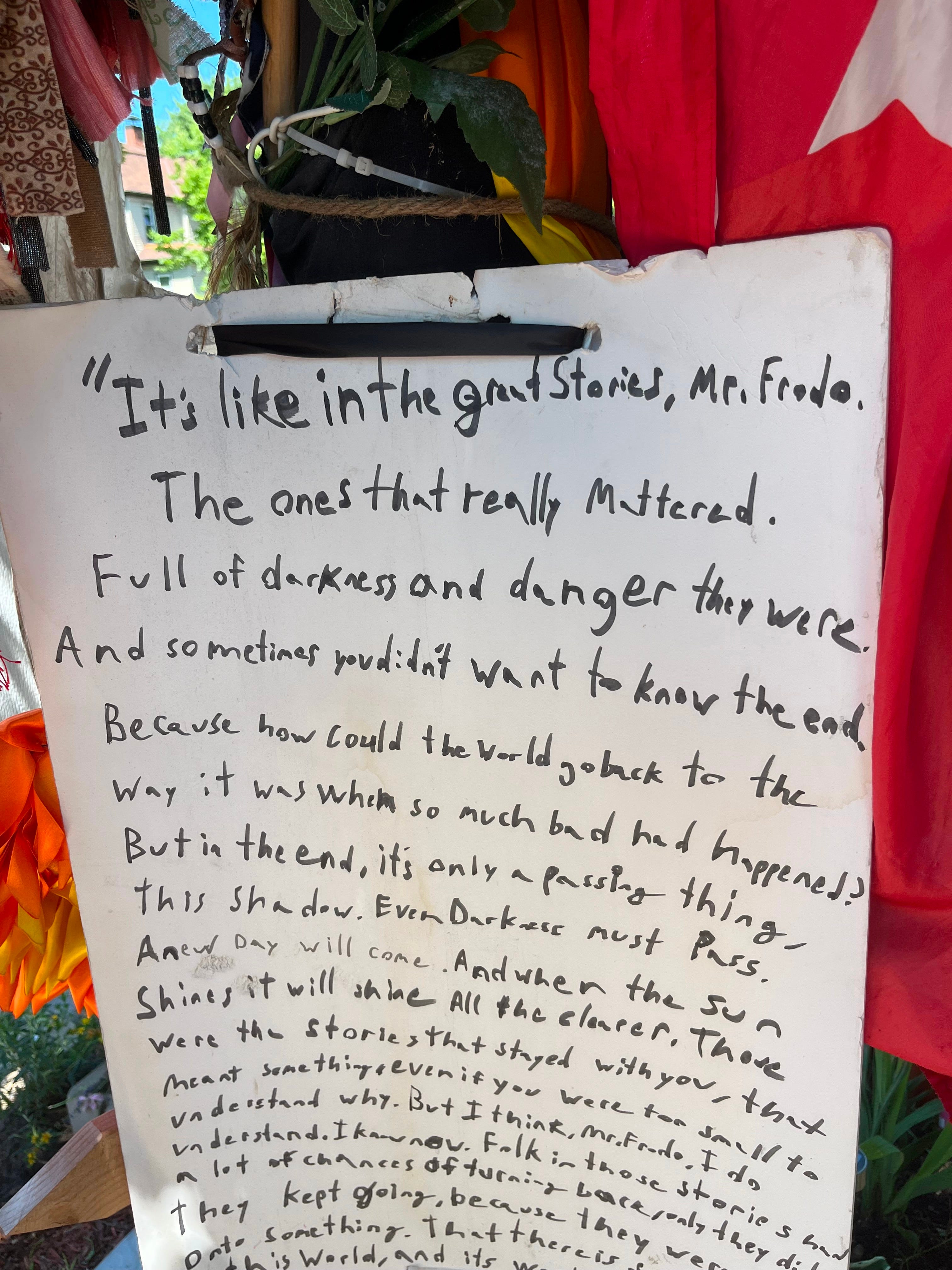
What I’ll probably remember most from that afternoon is the handmade sign from Renee Good’s memorial. The author had started at the top of a large sheet of white poster board, writing in big letters that grew progressively smaller as he or she tried to squeeze in the complete passage from The Lord of the Rings.
“It’s like in the great stories, Mr. Frodo. The ones that really mattered. Full of darkness and danger they were. And sometimes you didn’t want to know the end. Because how could the end be happy? How could the world go back to the way it was when so much bad had happened? But in the end, it’s only a passing thing, this shadow. Even darkness must pass. A new day will come. And when the sun shines it will shine out the clearer. Those were the stories that stayed with you. That meant something, even if you were too small to understand why. But I think, Mr. Frodo, I do understand. I know now. Folk in those stories had lots of chances of turning back, only they didn’t. They kept going, because they were holding on to something. That there is some good in this world, and it’s worth fighting for.”
--
Of course, the atrocities did not end in Minneapolis. On July 7 in Houston, Lorenzo Salgado Araujo was driving to his construction job when he was shot dead by ICE agents, under highly dubious circumstances. Last Monday in Maine, a 26-year-old Columbian national, Joan Sebastian Guerrero met a similar end. Neither man had been ICE targets.
For many of us, our capacity for outrage has been dulled over the last two years, but not our resolve. All of it will be front of mind when I cast my ballot in November. To make a kinder, more just world, we have many miles to travel and much work to do. And life is good. These things are simultaneously true. And someday, these will be the stories, to quote Tolkien, “that really mattered.”
Thank you, doctor!
Thank you and agreed!